The Palace was originally a place of delight in the Veronese countryside possession of the Moneta family: the first records of this family date back to 1557, the year in which Cosmo Moneta inherited the family assets, including the property of Belfiore on which, perhaps on an already existing site, he had his factory built.
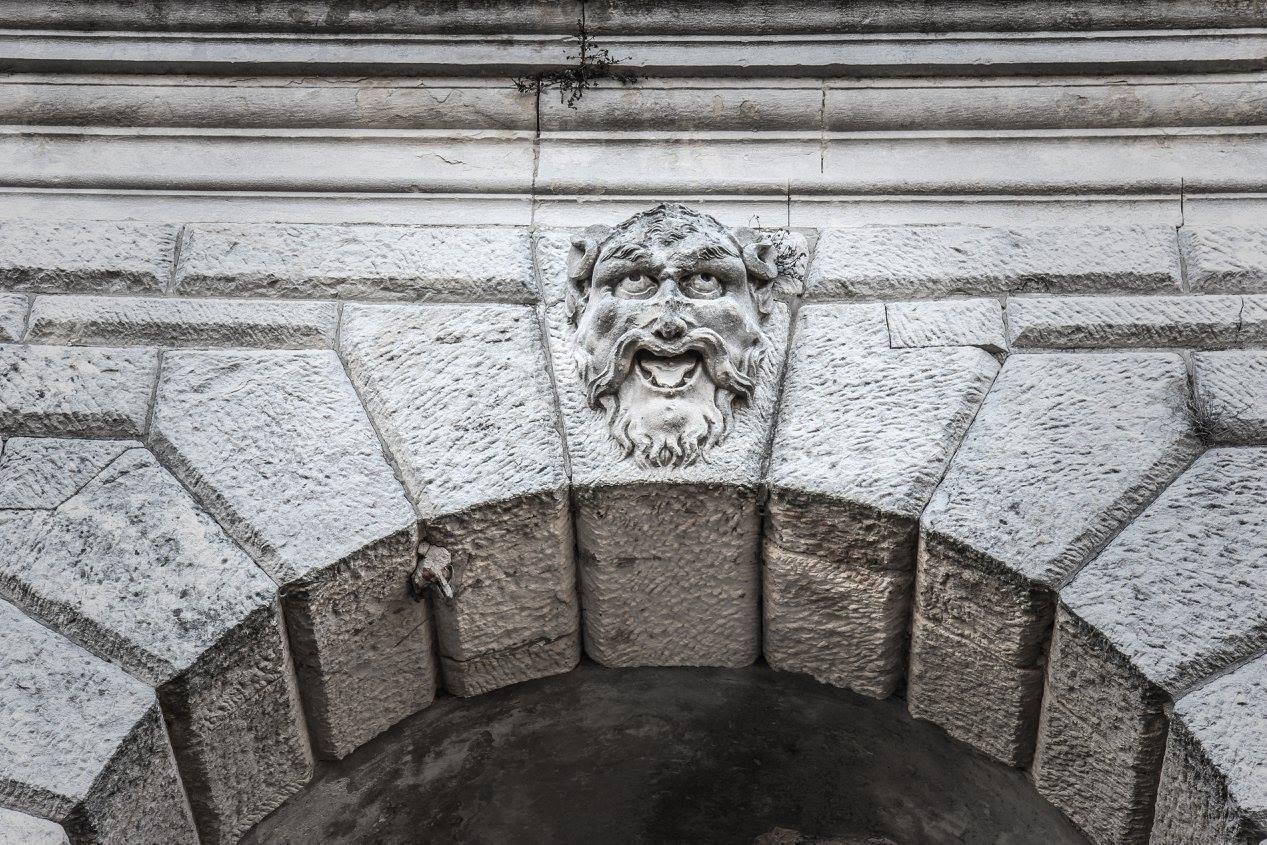
Palazzo Moneta has an exterior appearance that resembles more a city palace than a countryside villa: the building is a compact cubic structure, consisting of three floors, with the ground floor worked in ashlar stone, which particularly highlights the access portals of the symmetrical facades to the north and south.
Inside, there is a rich decorative apparatus from the time of the villa's construction, consisting of frescoes and stuccoes by famous artists such as Paolo Arinati, the Falconetto, and Bartolomeo Ridolfi.
On the ground floor, in the vestibules, vegetable motif decorations are visible; in an oculus at the center of the room, the “Abduction of Europe” was visible.
On the main walls, there are depicted two large scenes of battle and triumph, the work of Farinati, whose signature emerged during the restoration of the 1800s, along with the motif of the snail, the painter's signature.
From the central hall, through a corridor with a vaulted ceiling frescoed with a pergola of vines and another with grotesque decorations, you access the room “of the four seasons.” In this room, the stucco decorations attributed to Bartolomeo Ridolfi are noteworthy.
On the first floor, the room of “illicit loves” is famous for the theme of the depictions: Venus and Mars in front of the alcove while Apollo warns Vulcan, the legend of Priam and Thisbe, two other lovers who are courting by the waters of a pond.
It is precisely from the legend of Priam and Thisbe depicted at Palazzo Moneta that some authors argue Shakespeare drew inspiration for his “Romeo and Juliet”: the tragic love between the Babylonian lovers, later recounted by Ovid, and then by Matteo Bandello, was probably reinterpreted by the English bard who took the idea for the drama of the Veronese lovers.
In the Palace, an original architectural feature is given by the “stairs of the mules,” a spiral staircase made of terracotta by which the pack animals ascended to the granaries with the load to be stored.

 ${item.descriptiveTime && item.descriptiveDate.endsWith(item.descriptiveTime) ? item.descriptiveDate.slice(0, -item.descriptiveTime.length).replace(/[\\s/,-]+$/, '') : item.descriptiveDate}$

 ${item.regionTag}$
 Website