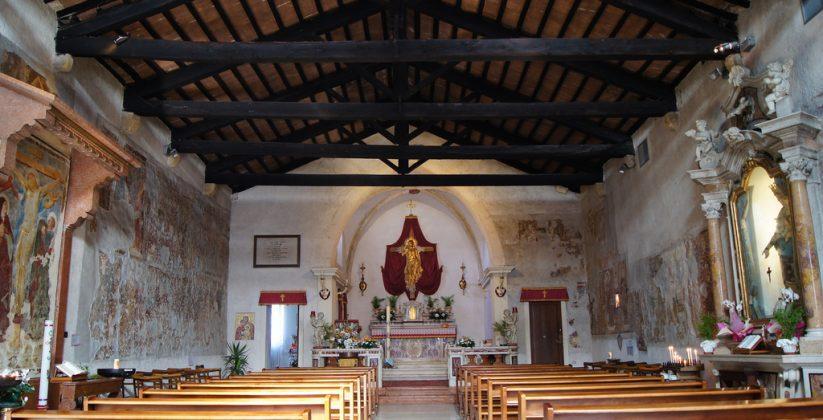
The church of San Felice is considered very old as it dates back to the 9th-10th century.
The tradition holds that San Felice (like Campiano) was a stop for Pope Lucius III on his journey to the Benedictine Abbey of San Pietro in Badia Calavena; it seems that the pope granted a special privilege to earn all the indulgences of the Roman Church for every Friday of the year.
After the adjacent convent was suppressed in 1867, a rector was appointed for the church. It was the very first rector, Don Domenico Brun, who revived interest in the frescoes within the building; among these is the beautiful Crucifix (recently restored) located on the left wall, an object of veneration for the local faithful.
The successor of Don Brun, Don Agostino Fracasso, in 1898, had the remaining walls stripped of plaster, thus bringing to light a jungle of frescoes by different authors and from various periods (ranging from the 13th to the 15th century).
All the elements that compose the church enhance the characteristics of the Romanesque style.
Its gabled facade is typical, with an arrangement of architectural elements symmetrically aligned to the apex of the roof. The front façade is preceded by a walled courtyard topped by an iron gate. The facade is characterized in all the openings (portal, windows, and rose window) by massive tuff outlines, which take on decorative aspects in their shapes and variations sensitive to light.
Everything concludes at the upper band with a protruding corbel topped at the ends by three pine cones with a cross.
The interior has a single nave, with a two-pitched roof, highlighted by truss structures, ending with an apse, covered with vaults with ribs.
The iconographic structure of the 14th-century frescoes, rich in details, colors, and painting knowledge, makes this sacred place one of the most expressive artistically. The frescoes depict significant moments in the life of Jesus, the Madonna on the throne, and Saints. Its fame, from the perspective of faith rooted in popular traditions, is linked to the pictorial representation of the Crucifix with the Madonna and Saint John on the sides.
On the left side of the triumphal arch, there is a plaque commemorating the visit of Pope Lucius III in 1185.

 ${item.descriptiveTime && item.descriptiveDate.endsWith(item.descriptiveTime) ? item.descriptiveDate.slice(0, -item.descriptiveTime.length).replace(/[\\s/,-]+$/, '') : item.descriptiveDate}$

 ${item.regionTag}$
 Website