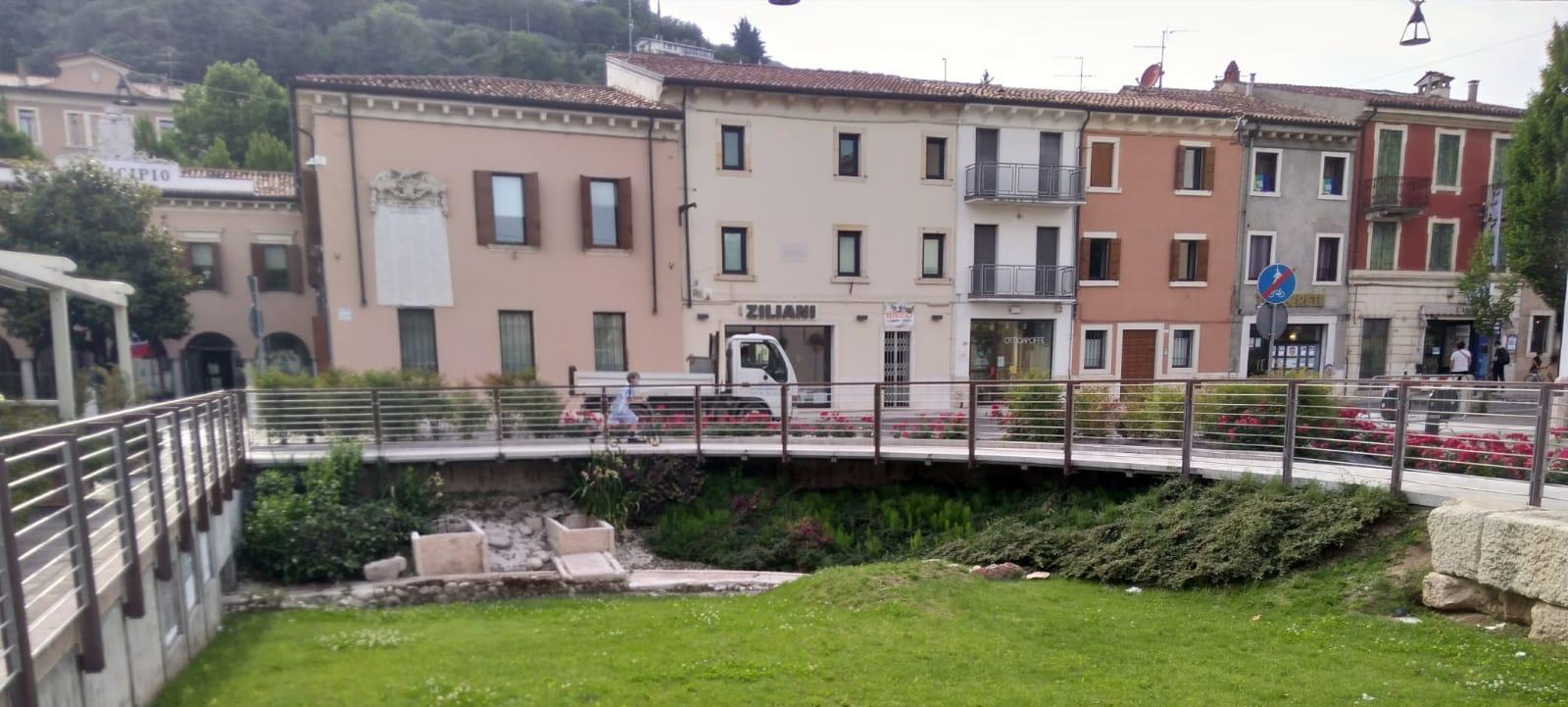
In the main square in Grezzana , there are ruins of Roman origin. This area was probably a necropolis (cemetery) as early as Roman times, as indicated by the tombs discovered in 1883 and 1886 in the area where the town hall is today. Observing the large curved blocks lined up in the square, recovered in 1860 during the excavation work for the demolition of the cemetery, and other similar blocks walled up in the apse of the nearby church of Sante Maria and Elisabetta, the dig inspectors, Carlo Cipolla and Stefano De Stefani, hypothesised that the blocks belonged to a large circular funerary monument from the Roman era. Their hunch was confirmed by the archaeological surveys carried out by the Superintendency from 2015 to 2017, which discovered the remains of circular lettering with a diameter of around 18 metres made up of large curved blocks of local limestone, skilfully worked and still partly preserved in situ. Inside, no floor plans or structures linked to the presence of a burial chamber have yet been identified. We can hypothesise that this tumulus mausoleum, which is exceptionally large for northern Italy, with an overall height that may have even reached 5–6 metres, functioned as a conspicuous reminder to passers-by, showcasing the wealth and social rank of whoever commissioned it; this person's tomb, together with those of other relatives, was probably situated in an adjacent space. The hypothesised age of the monument is based on topological comparisons: sepulchral monuments of this type were particularly widespread during the empire of Augustus (late 1st century BC – early 1st century AD), commissioned by rich and powerful figures and similar to the one the emperor wanted for himself in Rome. As the centuries passed, with the advent of the new religion of Christianity and the crisis and fall of the Roman Empire, the mausoleum, by that point in ruins, was demolished. For some burials, carried out with buried boxes made of stone slabs (stone box tombs) and used for several successive entombments, parts of tombs and other ancient constructions were reused, as in the case of the burial with a tombstone dated 2nd–3rd century AD (now on display in the entrance to the town hall). The area continued to be used as a parish cemetery until 1806; it later became a square home to the livestock market. Following works to reconfigure the town's urban space between 2015 and 2017, the ashlars were restored and repositioned in accordance with a hypothetical (but likely) reconstruction intended to indicate the dimensions of the ancient monument.
Roman Ruins in Grezzana square
Lessinia