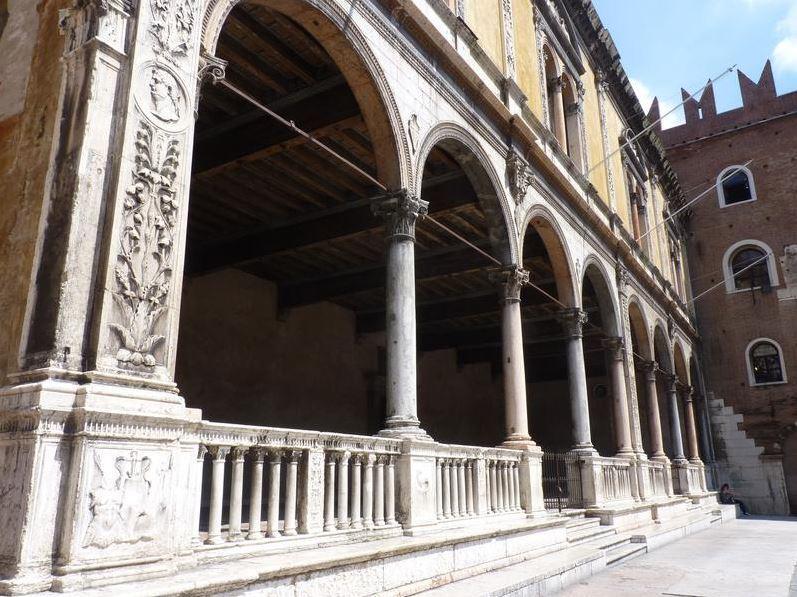
The “Loggia del Consiglio” was also called the “Loggia di Fra' Giocondo” because it was wrongly attributed to the famous Veronese architect “Fra' Giocondo”. It was built in 1476-93 according to the city elders’will of the municipal district of Verona. It was the seat of the meetings of the Citizens’ council (as a matter of fact just a formal institution because the Venetian rule prohibited any actual autonomy to the town).
In ‘800 the council was temporarily used as civil picture gallery and in order to allocate it to such a purpose it was dramatically rebuilt in 1820-38 and in 1870-74. The internal part (floors, ceilings, and painting decorations were changed) and the building was filled up with medallions and busts dedicated to Veronese important people (it was called the “promoteca”, established in 1810 and consisting in 110 carved pictures now preserved in the Civic Library in Verona).
Veronese humanists made the façade of the council, while the pictorial decoration, which covered the whole surface (the present one was remade in 1870), was made by Comacine artists. The building shows a porch with eight round arches while the first floor we can see four wide double lancet windows (a carved pediment and carved respond plasters).
At the top of the building there are the statues of renowned people of Roman Verona (Catullo, Plinio, Emilio Macro, Vitruvius and Cornelio Nepote), made by Alberto da Milano.
Inside the council rooms we can see some paintings commissioned by the Council in the XVI century; some other paintings of ‘500 and ‘600 were transferred to Barbieri Palace or were destroyed. The painting by Giambettino Cignaroli depicting Pomponio Trionfatore , dating half ‘700 is still intact.
The Council open gallery is now the seat of the meetings of the provincial council and of various cultural events.
On the arch that connects the Council open gallery to the Casa della Pietà (Mercy House), which was rebuilt in 1490 on residences dating back to the Scaliger period, it is situated the statue of Girolamo Fracastoro (famous Veronese doctor, poet and autonomous), carved by Danese Cattaneo in 1559.
Loggia del Consiglio
Historic center, Historic monument
Verona

Associated POI slider
${item.title}$
 ${item.descriptiveTime && item.descriptiveDate.endsWith(item.descriptiveTime) ? item.descriptiveDate.slice(0, -item.descriptiveTime.length).replace(/[\\s/,-]+$/, '') : item.descriptiveDate}$
 time:${item.descriptiveTime}$
 ${item.regionTag}$
 Website