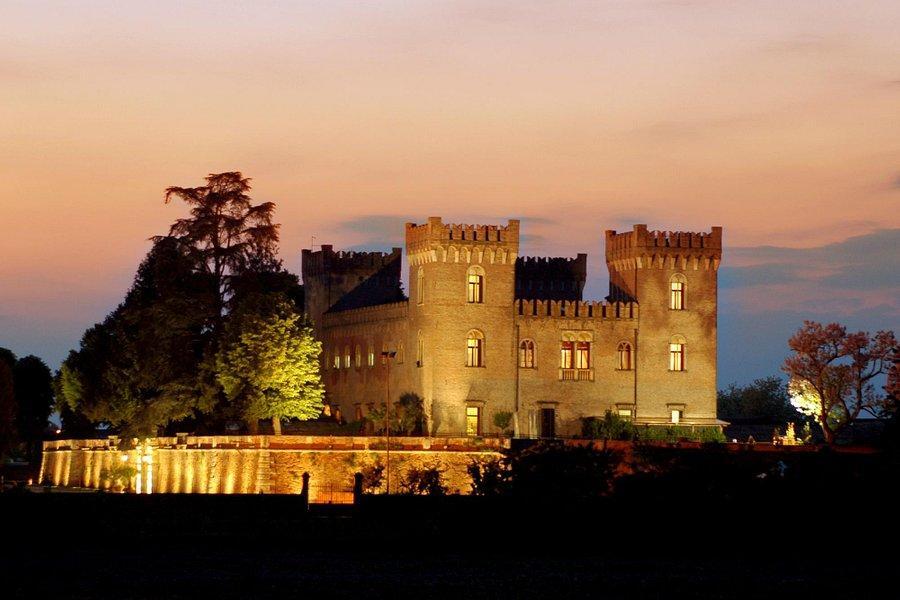
The Bevilacqua Castle was built in 1336 by Guglielmo Bevilacqua and was completed by his son Francesco on behalf of the Scaliger lordship of the time. It was conceived as a fortress to defend against the neighboring lordships, the Carraresi and the Estensi.
The Bevilacqua family originates from the village of Ala in the province of Trento, as demonstrated by the design of a wing at the center of the coat of arms. Guglielmo Bevilacqua, a skilled timber trader at the court of Can Grande Mastino della Scala, had solidified his economic passion within the Scaliger city of Verona, to the extent of receiving a regular investiture as Vassal of the bishop. His son Francesco was a key figure in the defense policy of the Scaliger border and expansion as a skilled ambassador, receiving honors from the Visconti, the Carraresi, the Estensi, and even from the pope of the time, Clement VI. The castle was damaged during the time of the so-called League of Cambrai and lost its defensive purpose in the subsequent period, under the full dominance of the Republic of Venice.
The building underwent modernization in 1532 by architect Sanmicheli, who transformed it into a villa and equipped it with large and modern interiors. In 1756, Gaetano Ippolito Bevilacqua restored and updated part of the interior of the castle, creating the large halls on the first floor, but not even a century passed before, following the Napoleonic events, the building was set on fire by the Austrian army (1848). The Austrian troops invaded the village and scattered the ashes of the then Count Alessandro Bevilacqua to the wind. The castle was restored several times by Countess Felicita Bevilacqua ten years later, along with her husband, General Giuseppe La Masa. It was given a crenellated crown, and the entire complex regained a neo-Gothic appearance in tune with the romantic taste of the time.
After the death of the couple, the heritage of the castle was bequeathed to charity. Thus, the "Bevilacqua - La Masa" foundation was born, which a few years later, through engineer Mutto, led to its transformation into the "Asilo di Quiete Bevilacqua - La Masa," a sort of residence for the elderly and needy. During World War II, it was occupied by the Germans as a Command Post. After the end of the war, the building became "Collegio San Davide," managed by the Salesians, who stayed until 1966 when, due to a boiler explosion, the castle was devastated by fire for the second time in its history. Abandoned by them, it was sold to private individuals. Only recently (1990) has the building, purchased by the Cerato family, been regaining its former splendor following meticulous restorations that allow visitors to admire a construction that holds almost 700 years of history within its walls.
Castello di Bevilacqua
Castle, Excursions, trips, guided tours
Pianura dei Dogi

Associated POI slider
${item.title}$
 ${item.descriptiveTime && item.descriptiveDate.endsWith(item.descriptiveTime) ? item.descriptiveDate.slice(0, -item.descriptiveTime.length).replace(/[\\s/,-]+$/, '') : item.descriptiveDate}$
 time:${item.descriptiveTime}$
 ${item.regionTag}$
 Website