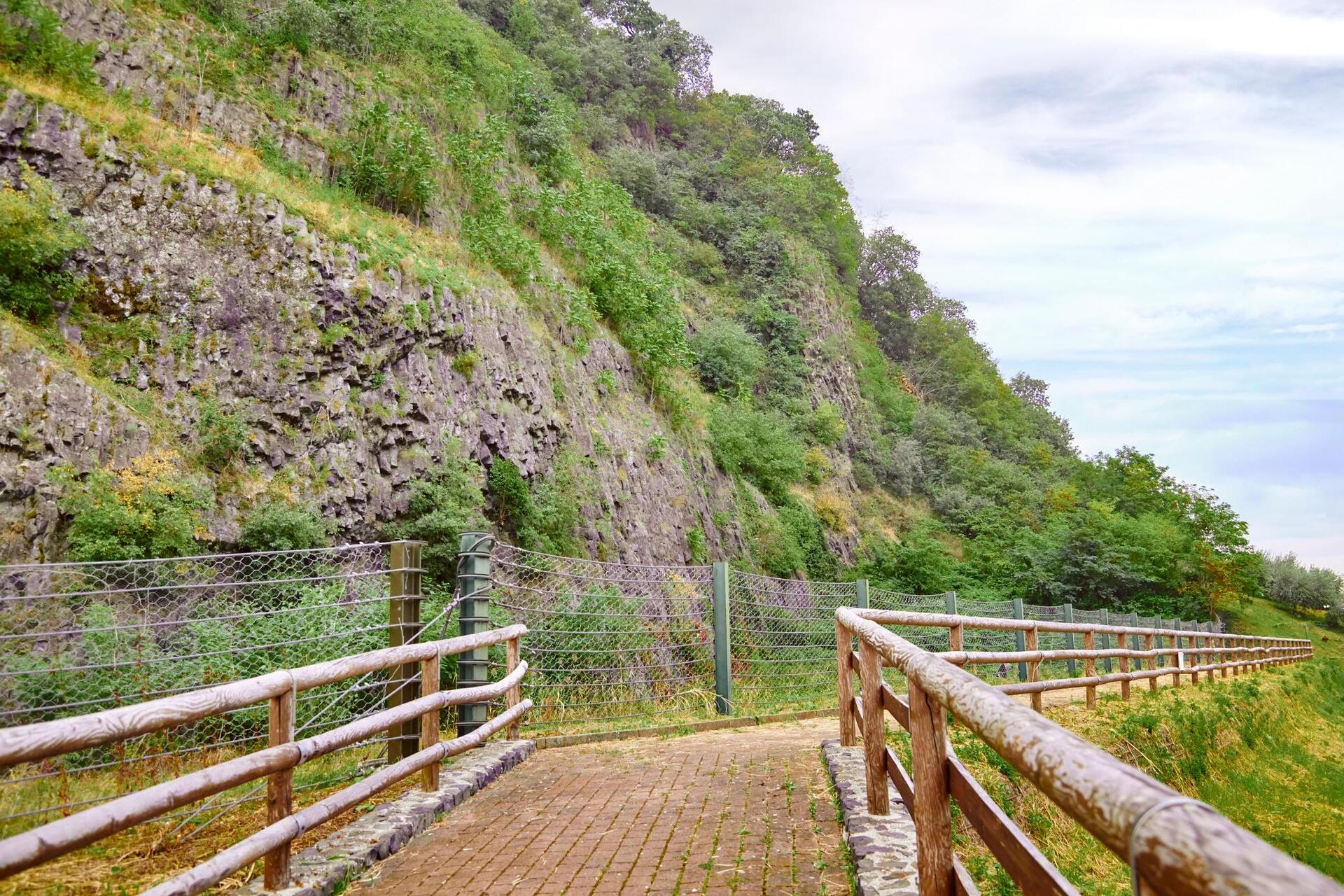
On the left side of the Alpone Valley, in San Giovanni Ilarione, a rocky wall appears like a huge beehive. It is, in fact, the imposing structure of columnar basalts, formed during Oligocene volcanism.
The cooling and contraction of the lava flows, around and inside the craters, gave rise to the prismatic forms with hexagonal bases, the shiny black columns closely packed together: an extraordinary natural scenery. In the middle Eocene, 45 million years ago, the coral reef of the "San Giovanni Ilarione horizon" was formed.
Its malacofauna includes dozens of new species of mollusks, in whose classification the term "hilarionis" recurs, adopted by paleontologists around the world. Since the early 1900s, this particular quarry provided work for hundreds of people and was one of the main avenues for the country's development in its early years. Located at the top of the rocky hill, the now-disused quarry is home to the small hamlet of Castello, an ancient Scaliger fortress.
Another place where one can admire the columnar basalts is in the Panarotti area (Devil's Mountain).